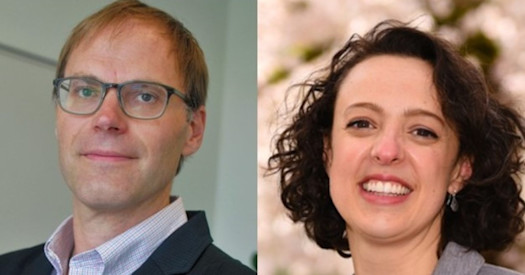
Lauren Beauregard, Executive Director of the CLOVES Syndrome Community, examines an experiment editing a portion of the PIK3CA gene, as BBI Research Lab Manager Nahum Smith looks on
“We go from bench to bedside. We go from technology development through data production, translating that into clinical information.”
Lea Starita, Ph.D., Brotman Baty Institute
Starita’s lab, along with those of Drs. Andrew Stergachis and Doug Fowler, is committed to ending Variants of Uncertain Significance (VUS), making precision medicine more informative, equitable, and impactful. With funding from Biohub's Rare As One project, all three labs are empowering rare disease advocacy groups with information, and sometimes, hope.
One of those advocacy groups is the CLOVES Syndrome Community. CLOVES is an acronym for Congenital Lipomatous Overgrowth, Vascular malformations, Epidermal nevi, and Skeletal/Spinal anomalies, a rare condition caused by a mutation in the PIK3CA gene. PIK3CA-related overgrowth spectrum (PROS) is an umbrella term for rare syndromes caused by somatic mutations (those only occurring in some cells) in PIK3CA. CLOVES Syndrome is characterized by complex vascular anomalies, including overgrown extremities, usually located on the arms or legs, as well as large, wide hands or feet; large fingers or toes; wide spaces between the toes and fingers; and asymmetrical body parts.
How rare is CLOVES Syndrome? Approximately 3,000 out of 8.3 billion people worldwide – and their loved ones – are dealing with it.
One person who has forgotten more about CLOVES than most people will ever know is Lauren Beauregard, whose 11-year-old daughter was diagnosed in 2015. Beauregard spent a day recently visiting BBI, meeting with all three labs’ principal investigators, along with researchers working on the science behind the disease.
“I learned that, with enough data from the PROS community, the Variant Effect Team may be able shed light on how different mutations, such as E542K and E545K, among others, affect the predicted course of CLOVES Syndrome, and other PROS conditions,” said Beauregard, Executive Director of the CLOVES Syndrome Community. “It was inspiring to see how the data from our CLOVES Syndrome Registry in the hands of these dedicated, compassionate scientists could be key in helping create a clearer, brighter future for people with CLOVES Syndrome and PROS.”
One of those “dedicated, compassionate” scientists is Annelise Mah-Som, M.D., Ph.D., a Clinical Researcher in the Stergachis Lab.
“We are assisting the Starita lab in gathering patient variants for use in calibrating their saturation genome editing assays as well as helping to interpret variant pathogenicity,” said Mah-Som.
In seeking to fulfill the promise of precision medicine, Starita said the research of her Advanced Technology Lab and Saturation Genome Editing Team “exemplify our mission to improve systems for characterization, modelling and interpretation of human genomic variation revealed by both clinical and population-based sequencing studies.”
 Clinical Researcher Annelise Mah-Som, M.D., Ph.D.: "Obtaining data on patients is a significant barrier to gaining greater clinical understanding of the CLOVES Syndrome."
However, because just over three-thousandths of 1 percent of people are affected by CLOVES, obtaining data on patients is a significant barrier to gaining greater clinical understanding of the disease, said Mah-Som.
“It is challenging to gather sufficient data regarding the types of PIK3CA variants that cause CLOVES and to understand if there is a genotype-phenotype correlation, or a link between specific genetic variants and the types and severity of symptoms they cause,” she said. “Any model we develop is only as good as the data we can put in it, which is limited in this case. It is also very challenging, especially for disorders where only some tissues are affected, to get samples to study.”
In contrast to challenges in the lab, Mah-Som said meeting with Beauregard provided insights for her and others in all three labs.
“It was very enlightening to learn about the struggles faced by individuals with CLOVES,” Mah-Som said. "It reminds us that there are real people's lives behind the data points. Lauren also discussed many of the reasons why genetic diagnosis is challenging in individuals with CLOVES, which is another limitation on our ability to gather variant data. I personally came away with great ideas that would be useful for our clinical practice. The disease cards are genius.”
That “genius” card is a handout entitled “You seem CURIOUS” that Beauregard and other members of the CLOVES Syndrome Community distribute to explain CLOVES. The cards are “designed to stop or steer unwanted questions, stares, and comments when out in public,” she said, and “puts the power back into the hands of people with CLOVES and their caregivers.”
 The CLOVES Syndrome Community "You seem CURIOUS" card is “designed to stop or steer unwanted questions, stares, and comments when out in public,” said Beauregard.
She also said funding from Biohub has been “instrumental” in helping the CLOVES Syndrome Community provide funding to scientists conducting research on PIK3CA.
“The work produced with our Biohub seed funding opened the door to much larger grants for those labs, resulting in big steps forward in terms of our understanding of PIK3CA and the role that PROS-related mutations have in the gene's function,” Beauregard said. “Within the scientific community, those projects and others have led to greater awareness of PROS and more interest in the study of the PIK3CA pathway.”
Mah-Som also is committed to taking an important step toward greater understanding of CLOVES and similar vascular diseases.
“I am investigating the barriers for hosting a multidisciplinary vascular anomalies clinic at UW, as Lauren had mentioned that there is a need for such adult clinics to streamline care,” she said.