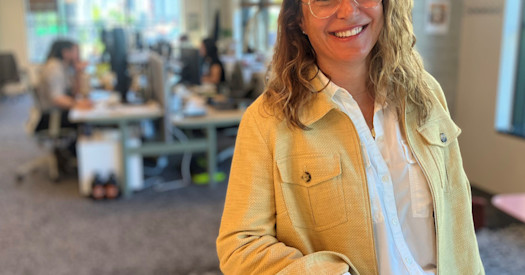
Stephanie Sansbury: 'She excels at identifying ways to incorporate novel genomic technologies into her work, and she is not afraid to try new things.'
Ask Stephanie Sansbury what she wants to work on and she will give you a list. Ask her how she decides where to focus, and you will understand what makes her a serious scientist.
“There is so, so much science I want to do,” said Sansbury, 33. “I've had to be very deliberate about where I direct my time and energy.”
When Sansbury graduated from high school 15 years ago, she was interested in biology, but thought she would become a writer. She had taken “a lot of humanities courses and English classes.” Science, she said, “was something I enjoyed, along with many other pursuits.”
Those other pursuits included public policy involving the Middle East and North Africa, an interest she attributes to her mother working at the World Bank. Sansbury entered the University of Maryland in 2011 as a biology major.
“There were five or six different biology majors at U of M, and I cycled through several of them before landing on cell biology and genetics,” she said. “Evolutionary biology, Microbiology, and others. I enjoyed them all.”
She graduated in 2015 with a Bachelor of Science degree in Cell Biology and Molecular Genetics with highest honors and Phi Beta Kappa. She also earned a second Bachelor’s Degree – in Arabic Studies. After working as a research technician in the Biochemistry Department at the University of Maryland, Sansbury completed her Ph.D. in Genetics and Epigenetics at the University of Pennsylvania, navigating delays related to the COVID-19 pandemic.
One month later in June of 2024, she arrived at the University of Washington as a post-doctoral scholar at the Institute for Protein Design and embarked on her current project: devising ways to use protein design to identify strategies to get therapeutics inside cells. Sansbury was also selected as a post-doc fellow last January for SeaBridge, the translational research training program affiliated with the Seattle Hub for Synthetic Biology.
As part of the SeaBridge application, Sansbury’s personal statement offers a glimpse into the ethical and principled beliefs behind her commitment to science:
I consider myself fortunate to have secured a position in the right place and at the right time – both in the sense of learning protein design at a time of extraordinary promise, and in terms of the opportunities for structured mentorship and programming that the newly-minted SeaBridge Fellowship may provide. Compared to a similarly positioned person, what may set me apart is my belief that I bear a moral obligation to use my training to find better treatments for disease.
Sansbury is one of eight SeaBridge fellows incorporating SeattleHub’s cell and genome programming technologies into their individual research projects in laboratories at the UW or Fred Hutch Cancer Center. Each fellow receives two years of financial support, as well as funding for a structured career development curriculum, mentorship training, and networking opportunities. They are supported by a $10 million grant from the Washington Research Foundation, with additional funding from Biohub and the UW Medicine Brotman Baty Institute.
SeaBridge seeks to diversify SeattleHub technologies into new companies to commercialize novel therapeutics, diagnostics, or other cell-based technologies. The ultimate goal is to offer new clinical interventions to improve patients’ lives.
It's evident those interventions are at the top of Sansbury’s mind as she explained her efforts to implant drugs into individual cells.
“One of the reasons drug delivery is hard is that our cells are really smart and have evolved ways to keep foreign objects out,” she said. “So, sometimes you have to deliver a dose of 100 or 1,000 times more drug than you actually need just so that little bit gets into cells. This seemed like a great challenge to tackle with protein design, which might be able to come up with a solution that evolution’s never seen before.”
But the challenge, Sansbury said, is a obtaining a readout that explains what is happening inside the individual cell.
“So that’s where this idea came from: ‘For the purposes of screening delivery vehicles, could our “drug” essentially be a barcode that we try to get into a cell?’” she said. “The barcode would let us identify which of the proteins we designed actually succeeded in improving delivery rates. And instead of testing 100 proteins at a time, and finding, maybe, one of them with the desired activity, barcoding the designs enables me to test 10,000 or 100,000 in a single experiment, determine which work, how well they work, and measure how their activity affects the health of the recipient cells afterward.”
That’s where SeattleHub, and specifically, Florence Abadie, Ph.D., comes into the equation. Abadie leads the “Read Team” that tracks cell lineages and biological signaling events by reading out the identity and sequential order of DNA barcodes marking those events.
Abadie also serves as Sansbury’s SeaBridge mentor.
“Stephanie is curious, asks sharp questions, and is incredibly thorough in her scientific thinking,” Abadie said. “She excels at identifying ways to incorporate novel genomic technologies into her work, and she is not afraid to try new things. I believe these qualities of hers will serve her well in her career as a researcher.”
Trying new things may well be the essence of Sansbury’s character.